This is the question I get more than any other. Not what to eat, not when to eat it. Just how much protein am I supposed to be having. And the reason nobody seems able to answer it for you is that the number you find when you go looking is answering a completely different question from the one you are asking.
So let me give you the number I actually use with clients, and then let me show you why the official one is less than half of it.
The number I give my clients
One gram of protein per pound of your goal body weight. Or per pound of your lean muscle mass, if you happen to know that figure.
Read that again, because the word people skip over is goal. Not what you weigh this morning. What you are working toward.
If you weigh 190 and you are working toward 150, your number is 150 grams. Not 190. That distinction does two things. It gives you a target that does not move every single time the scale does, and it keeps the number sensible for someone who is carrying weight they are actively working to lose.
That is where I start the majority of the people I work with. We adjust from there based on your feedback and what your life actually looks like, but that is the number we begin with.
Why the official number is so much lower
The RDA for protein is 0.8 grams per kilogram of body weight, which works out around 0.36 grams per pound. For that same person aiming at 150 pounds, the RDA lands somewhere near 62 grams a day.
That is a big gap. So which one is wrong?
Neither, and this is the part almost nobody explains. That 62 grams is the amount that keeps you from becoming malnourished. It is the bare minimum. When the Institute of Medicine looked at it again, they said so plainly: it is the least you need to avoid a deficiency, not the amount you need to be healthy.
The RDA is the amount that prevents malnutrition. It was never the amount that builds anything.
So that number is not promising you will hold on to muscle while you lose fat, or stay full through the afternoon, or recover from your workouts, or keep your strength as you get older. It was never measuring any of that in the first place. Somewhere between that document and the internet, a bare minimum turned into a target.
What the research actually supports
I am not asking you to take my word over a government guideline, so here is where the evidence sits.
A 2018 review pooling 49 studies and 1,863 people found that the benefit of extra protein for building muscle alongside strength training keeps climbing until roughly 1.6 grams per kilogram a day, which is about 0.73 grams per pound. Past that point the extra protein stopped adding anything measurable.
Now here is the thing. When I work out one gram per pound of goal weight for most of the women I coach, it lands almost exactly on that same number. That is not a coincidence, and it is the whole reason I use goal weight instead of what you weigh today.
The case gets stronger when you are eating in a deficit. A 2016 trial put people on a steep calorie deficit alongside hard training. The group eating 2.4 grams per kilogram gained lean mass while losing fat. The group at 1.2 grams per kilogram held on to their muscle but did not gain any. I will be straight with you about that one though. It was young men aged 18 to 30, not women in their forties, so I am not going to pretend it maps neatly onto you. It points the same way as what I see with my own clients, and that is as far as I will take it.
And if you are over about 50, the argument for more protein gets stronger rather than weaker. Research groups looking specifically at aging have recommended intakes above the RDA to protect against muscle loss, not below it.
But is that much protein bad for you?
Every so often this question comes up with a client, so let us talk about it.
A 2018 review pulled together more than two dozen studies on kidney function in healthy adults. It found no difference between the people eating more protein and the people eating less.
The word doing the work in that sentence is healthy. If you have existing kidney disease, this is a conversation for your doctor and not for a blog post. The same goes if you are pregnant, managing a medical condition, or following a diet your doctor set for you. For everybody else, the fear is a great deal bigger than the evidence sitting behind it.
You are probably not eating too much
In practice, almost nobody has ever come to me eating too much protein. The overwhelming majority are getting about half of what they need and cannot work out why they are starving by 3pm and losing strength in the gym.
Here is what tends to happen when somebody finally gets their protein up. The evening grazing stops. The afternoon crash softens. They stop shedding muscle alongside the fat, which is the whole difference between ending up smaller and ending up stronger. And the change they mention first is almost never on the scale. It is that they are not thinking about food all day. I have watched it play out more times than I can count. Somebody arrives convinced the answer is to eat less, we put her protein up instead, and the weight comes down, her clothes fit differently, and she is eating more food than she was when she started.
That last part is the one that catches people off guard every single time.
How to actually hit it
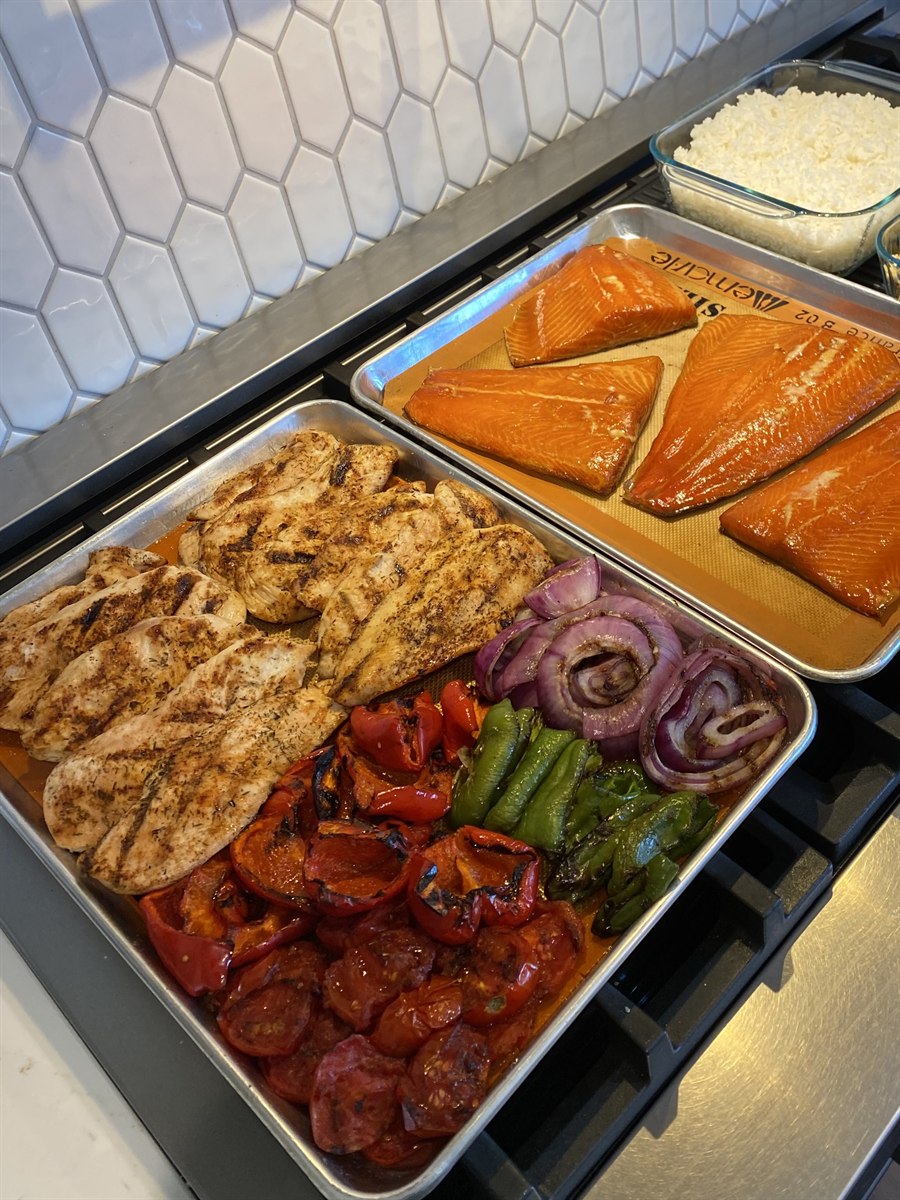
Knowing the number is the easy half. Hitting it takes a couple of weeks of adjusting, and the usual mistake is trying to get there by bolting a chicken breast onto a day that is already built wrong.
What works is getting protein in every single time you eat, instead of back-loading it all onto dinner. I tell people to aim for roughly 30 grams a time.
And you do not have to do that in three sittings. Three big meals is a lot of food to force down in one go, and plenty of people find it genuinely uncomfortable. Four or five smaller meals at around 30 grams is much easier to live with, and it is where most of my clients end up. A high-protein snack absolutely counts. That is not cutting corners, that is just how you get there.
- Work your number out once. Goal weight in pounds, one gram per pound. Write it down somewhere you will see it
- Aim for roughly 30 grams every time you eat, and eat more often if that suits you better. Snacks count
- Fix breakfast first. It is where nearly everybody loses 20 to 30 grams before the day has properly started
- Look at the food already in your fridge before you buy anything new. Most people are surprised by what is in there
- Track it for two weeks. Not forever. Just long enough to learn what 30 grams actually looks like on a plate
That last one is what changes things. Almost everyone badly overestimates how much protein is in a meal until they have measured it a few times. Two weeks of paying attention buys you a skill you keep for good.
What 30 grams actually looks like
Since I have just told you that you are probably overestimating, it is only fair that I show you. These are approximate and they do vary by brand, so check your own labels, but they will get you close:
- A 4oz chicken breast, cooked, is roughly 35 grams
- 4oz of lean ground beef or turkey, cooked, is roughly 30 grams
- A 5oz can of tuna is roughly 25 to 30 grams
- One cup of cottage cheese is roughly 25 grams
- A scoop of protein powder is usually 20 to 25 grams
- A single-serve container of plain Greek yogurt is roughly 15 to 20 grams
- Three whole eggs is roughly 18 grams
A few of those clear 30 grams on their own. Most of them need a partner. Three whole eggs, which nearly everybody would call a proper protein breakfast, comes in around 18 grams, so it needs a side of cottage cheese or a yogurt alongside it to get where it needs to be.
Now look at that list, and then think about what you actually ate yesterday. For most people, that is the moment it clicks.
The recipes below are the ones I point people at when they are trying to close the gap, and breakfast is where I would start.
If you take one thing from this
Your number is one gram per pound of your goal weight. The official guideline is less than half of that because it is answering a question about deficiency, not a question about strength.
You are almost certainly eating less than you think you are. Work out your number this week, and give it two weeks before you decide whether it is doing anything.
Studies referenced
- Morton RW et al. (2018). A systematic review, meta-analysis and meta-regression of the effect of protein supplementation on resistance training-induced gains in muscle mass and strength in healthy adults. British Journal of Sports Medicine.
- Longland TM et al. (2016). Higher compared with lower dietary protein during an energy deficit combined with intense exercise promotes greater lean mass gain and fat mass loss. American Journal of Clinical Nutrition.
- Wolfe RR et al. (2023). Is It Time to Reconsider the U.S. Recommendations for Dietary Protein and Amino Acid Intake? Nutrients.
- Devries MC et al. (2018). Changes in Kidney Function Do Not Differ between Healthy Adults Consuming Higher- Compared with Lower- or Normal-Protein Diets. Journal of Nutrition.
- Traylor DA, Gorissen SHM, Phillips SM (2018). Perspective: Protein Requirements and Optimal Intakes in Aging: Are We Ready to Recommend More Than the Recommended Daily Allowance? Advances in Nutrition.